Blog
AI Music vs Traditional Music: Which Production Approach Fits Your Project?
AI music vs traditional music compared for creators: speed, cost, creative control, quality, copyright, and hybrid workflows that combine both methods.
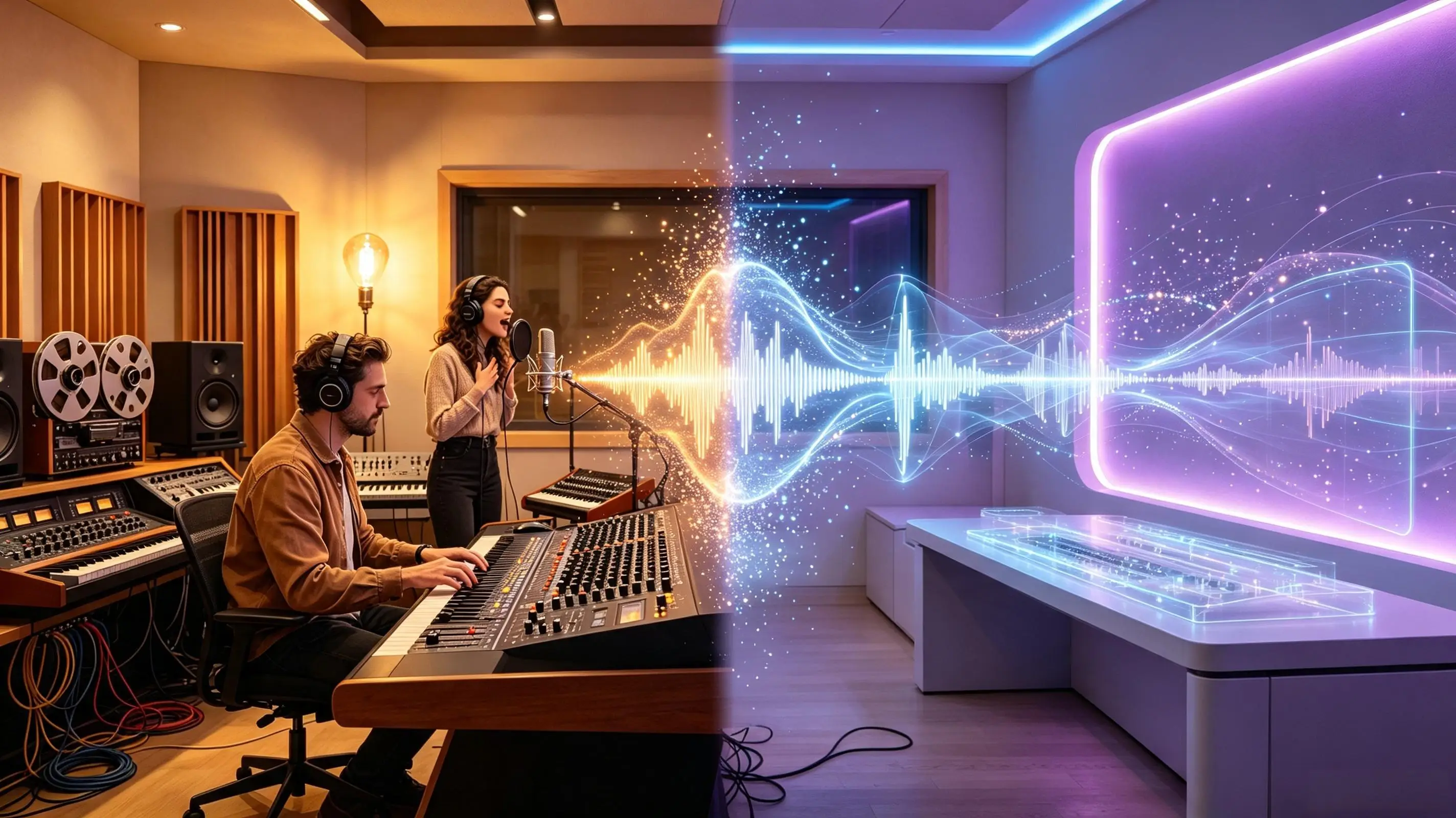
AI music vs traditional music is a practical comparison between two production paths. One path uses machine-generated output. The other relies on human-led composition, performance, recording, and editing. Your choice affects speed, production cost, creative control, copyright, and monetization. It also decides how much work you will do inside a DAW. This article compares both methods stage by stage, from ideation to final release, and shows how creators decide between them.
What Is the Difference Between AI Music and Traditional Music Production?
AI music production uses generative models to create or modify musical material. Traditional production keeps people in direct control of composition, performance, recording, and finishing. The real distinction is not the software in the studio. It is where creative decisions originate, and who can revise them.
What Counts as AI-Generated Music?
AI-generated music comes from several tool types. These include prompt-to-track systems, generative composition tools, synthetic singing models, and software that builds arrangements from text, lyrics, or reference audio. The result can be a finished stereo track, separate stems, an instrumental, or a full song with vocals.
What Counts as Traditional Music Production?
Traditional studio production is human-led from the first idea to the final master. A songwriter develops the composition. Musicians interpret their parts. An engineer records the performances. Producers make deliberate decisions about arrangement, editing, dynamics, space, and tone. This can happen in a commercial facility or a bedroom studio.
Where Does AI-Assisted Music Fit?
AI-assisted music sits between these two categories. A producer might generate eight arrangement ideas. They keep one chord progression, replace the vocals, and replay the bass. Then they mix the rebuilt session manually. The finished recording is neither fully generated nor entirely traditional. Its production notes should therefore identify the meaningful human contributions.
AI Music vs Traditional Music: Quick Comparison
AI music wins on speed, accessibility, and output volume. Traditional production wins on precise direction, expressive performance, and artistic identity. Hybrid production is often the strongest operational choice. It gives you a fast draft, then detailed revision and a defensible creative process.

| Decision factor | AI generation | Traditional production | Hybrid production | Best fit |
|---|---|---|---|---|
| Speed | Often minutes per draft | Often days or weeks | Fast start, slower finish | AI for deadlines |
| Cost | Low initial spend | Labor and studio costs | Moderate | Depends on finish |
| Skills | Briefing and selection | Writing, playing, engineering | Prompting plus DAW skills | AI for entry |
| Creative control | Indirect | Detailed | Detailed after export | Traditional or hybrid |
| Performance | Model-dependent | Directable | Replaceable | Human for featured parts |
| Emotional nuance | Can sound convincing | Intentionally shaped | Humanized selectively | Flagship releases |
| Revisions | Often regenerate | Edit exact elements | Edit available stems | Hybrid with stems |
| Originality | Similarity must be checked | Traceable decisions | Improved by rebuilding | Artist identity |
| Scalability | High | Limited by labor | Medium to high | Content libraries |
| Copyright risk | Terms and authorship vary | Established rights chain | Requires documentation | Review before release |
Where AI Music Has the Advantage
AI works well for rapid prototypes, alternate moods, short social edits, podcast beds, and projects that need many variations. Its low learning barrier lets a marketer test musical direction before booking a composer or a studio.
Where Traditional Production Has the Advantage
Human-led sessions allow exact changes. A director can soften one lyric, delay a snare hit, alter a singer's breath, or reshape tension across sixteen bars. Those decisions support distinctive performance. They also build a consistent artistic identity.
Why Hybrid Production Is Often the Practical Choice
A hybrid workflow treats generated audio as raw material, not a final answer. Human editing, recording, mixing, and mastering can fix the weak spots. These include generic structure, unstable vocals, crowded frequency balance, and abrupt transitions.
How Do AI and Traditional Methods Create a Song?
AI creates a song by interpreting a prompt or other input. Traditional production builds the same result through explicit writing, performance, recording, and engineering decisions. Both paths still need a person. Someone must set the brief, judge quality, confirm rights, and prepare the release.
| Stage | Traditional process | AI process | Human responsibility | Typical tools | Time | Quality check |
|---|---|---|---|---|---|---|
| Ideation | References and sketches | Prompt variations | Set purpose | Notes, generator | Minutes to days | Brief alignment |
| Lyrics and composition | Write and revise | Generate options | Edit meaning and melody | Instrument, lyric tool | Hours to weeks | Prosody and originality |
| Arrangement | Build each section | Model assembles form | Fix pacing | DAW, generator | Minutes to days | Transitions |
| Recording or generation | Direct performers | Render audio | Select or replace takes | Studio, song generator | Minutes to sessions | Artifacts and tuning |
| Mixing | Balance multitracks | Often pre-mixed | Correct stems or stereo file | DAW, FUZZ tools | Hours to days | Clarity and dynamics |
| Mastering | Prepare final master | Automated or manual | Match delivery target | Metering, mastering tools | Minutes to hours | Loudness and clipping |
| Distribution preparation | Credits and agreements | Terms and model records | Verify rights | Distributor forms | Hours | Metadata and license |
Ideation, Lyrics, and Composition
A songwriter can explain why a chord, rhyme, or melodic pause matters. A generator returns patterns that fit the request, but it does not share that intent. For an editable starting point, write lyrics separately or use the AI song generator for full songs with vocals. Then revise weak phrases before production. If you are new to the tools, start with our five-minute beginner guide.
Arrangement, Performance, and Recording
Generated arrangements can establish genre and energy quickly. But they may repeat sections too literally or introduce changes without preparation. Traditional sessions make every part directable. This ranges from drum articulation to the emotional arc of a lead vocal. To understand the technology behind the output, see how AI instrumental music generation works.
Mixing, Mastering, and Distribution Preparation
A stereo generation offers less repair access than a multitrack recording. Stems improve editability, but separation can leave bleed or phase artifacts. Final checks should cover mono compatibility, clipping, vocal intelligibility, metadata, contributor credits, and platform rights.
How Much Time and Money Does Each Approach Require?
AI generally requires less time and less upfront spending. Traditional production gives a team more predictable control over revisions and final quality. Actual cost depends on several factors. These include track length, iteration count, performers, studio rates, editing needs, and the commercial license attached to the tool.
AI Music Costs and Time Commitments
- Generation can take minutes. But evaluating ten drafts may take longer than producing the first one.
- Subscriptions or credits are only part of the cost. Stem cleanup, vocal replacement, mastering, and rights review all add labor.
- Prompt development gets faster once a team builds reusable briefs for mood, duration, structure, and instrumentation.
A YouTube editor needs a 30-second technology bed. They may audition six AI drafts in an hour and trim the best result. The same editor might still spend another hour on the ending, the license, and matching loudness to dialogue.
Traditional Production Costs and Time Commitments
A traditional project can include songwriting sessions, musician fees, rehearsal, studio booking, engineering, editing, mixing, mastering, and project management. The expense is higher. But a producer can request one targeted correction. They do not have to regenerate the whole performance and hope the rest survives.
Accessibility Versus Professional Control
AI lowers the skills needed to hear a credible draft. Traditional tools reward years of ear training and performance practice. Hybrid work requires enough DAW knowledge to set tempo, edit stems, replace parts, automate dynamics, and export a sound master.
Is AI-Generated Music Quality as Good as Human Music?
AI-generated music can match the surface polish of human music in suitable genres. It is less dependable in structure, expressive intent, and fine-grained revision. Quality varies with several inputs. These include the model, prompt, genre, track length, source material, and the amount of human finishing.
Technical Sound Quality and Production Consistency
Listen past the first chorus. Common failure points include smeared consonants, unstable vocal identity, cymbal wash, implausible instrument attacks, excessive repetition, abrupt transitions, and flat dynamics. Genre matters too. A dense electronic bed can hide minor artifacts. An exposed acoustic ballad makes them obvious. For a closer look at vocal evaluation criteria, see which AI song generators have the most human-like vocals.
Emotion, Intent, and Perceived Authenticity
Convincing timbre is not the same as intentional expression. A human singer can connect a breath, a timing change, or a cracked note to the lyric's meaning. An AI performance may sound emotional. But it can lack a consistent reason for how that emotion develops across the song.
Originality and Artistic Identity
Generators are efficient at producing recognizable genre signals. Artists are stronger at building a coherent identity. They use personal context, collaboration, unusual constraints, and deliberate rule-breaking. For a flagship single, recognizable authorship often matters more than instant polish.
How to Run a Blind-Listening Test
A blind test is the most honest way to judge the two methods. Export an AI draft and a human-made version of the same brief. Match their playback loudness. Hide the filenames. Ask at least three listeners to score each track from 1 to 5 on the criteria below. Collect comments before you reveal which track is which.
| Criteria | What to listen for |
|---|---|
| Hook | Does the main idea grab attention and stay memorable? |
| Arrangement | Do the sections build, contrast, and resolve? |
| Vocal phrasing | Does the voice shape each word with intent? |
| Transitions | Do changes land cleanly or feel abrupt? |
| Sound quality | Any artifacts, smearing, or unnatural attacks? |
| Emotional impact | Does the track move the listener over time? |
| Replay value | Would you listen again end to end? |
Score both tracks with the same sheet before comparing notes. In a controlled test, you would expect transition quality and long-range dynamics to separate the two methods before isolated sound fidelity does. If you run the same procedure with your own material, keep the brief, loudness matching, and scoring sheet identical so the results stay comparable.
How Can You Build a Hybrid AI and DAW Workflow?
A hybrid AI and DAW workflow uses generation for fast ideation. It then gives people control over arrangement, performance, editing, mixing, and the final master. The aim is to keep useful musical material. You replace the weak or legally sensitive elements.
The workflow at a glance:
- Write a specific creative brief.
- Generate six to ten drafts with AI.
- Score each draft against the same brief.
- Export the best mix or stems into a DAW.
- Rebuild the arrangement and replace weak performances.
- Mix, master, and run quality checks.
- Verify rights, credits, and metadata before release.
Step 1: Write a Specific Creative Brief
Define the audience, use case, duration, mood, tempo range, structure, instrumentation, vocal type, lyrical perspective, and prohibited references. A brief like "upbeat indie pop" is too broad. Describe where the energy should rise and how the track must end.
Step 2: Generate and Evaluate Multiple Drafts
Use the AI music generator for rapid instrumental drafts. Or use editable AI lyrics before creating a vocal version. Score each draft against the same brief. Do not just choose the first polished result.
Step 3: Move the Best Idea Into a DAW
Export the available mix or stems. Record the source details and confirm usage rights. Align the audio to the session tempo. Label generated material clearly. Remember that stem separation is not a true multitrack recording. Check bleed and transient damage before heavy processing.
Step 4: Add Human Arrangement and Performance
Shorten repetitive sections. Rebuild transitions. Replace the lead vocal or featured instrument. Add automation that creates intentional contrast. Ailume's AI Music Producer, based on the FUZZ model, can support multitrack, mixing, and mastering work before or alongside manual DAW edits.
Step 5: Mix, Master, and Run Quality Checks
Check headphones, speakers, mono playback, vocal artifacts, low-frequency balance, and clipping. Confirm the delivery platform's format requirements. Run a similarity review. Verify credits and licenses. Retain the prompt, exports, edits, contributor agreements, model details, and final master.
What Copyright and Ethical Risks Should Creators Check?
Creators must check several issues before releasing AI-generated music. These include commercial rights, input ownership, authorship, imitation, samples, and distribution rules. Traditional production usually has a more familiar rights chain. It still requires written agreements and sample clearance.
The rules in this section describe U.S. law as of August 2026. The U.S. Copyright Office's Part 2 report on copyright and artificial intelligence was published in January 2025. It states that copyright does not extend to purely AI-generated material. Human-authored selection, arrangement, or modification may qualify. The U.S. Copyright Office's AI resource page tracks these rules as they change. Other markets are developing their own approaches, including the UK Intellectual Property Office and the European Commission. Check the law that applies where you release the track. This page is general information, not legal advice. For a focused discussion, read our AI music copyright guide.
| Risk area | Question | AI consideration | Traditional consideration | Evidence | Risk reduction |
|---|---|---|---|---|---|
| Commercial license | Does the plan permit monetization? | Terms may differ by tier | Contracts define use | Dated terms | Archive the license |
| Training data | Is sourcing explained? | Transparency varies | Usually not applicable | Policy copy | Prefer clear policies |
| Inputs | Do you own every upload? | Prompts and audio may carry rights | References can create disputes | Source files | Use owned inputs |
| Voice or style imitation | Could a person be identified? | Publicity and false endorsement risk | Impersonation also applies | Brief and approvals | Avoid named imitation |
| Samples | Are all samples cleared? | Outputs need similarity review | Libraries need licenses | Receipts | Replace uncertain audio |
| Collaborators | Who owns each contribution? | Human edits need records | Splits need agreement | Signed splits | Agree before release |
| Authorship | What did a person create? | Pure generation may lack protection | Authorship is clearer | DAW history | Document human work |
| Distribution | Does the service accept the track? | Disclosure rules may apply | Metadata rules apply | Submission record | Check current policy |
Commercial Licenses and Platform Terms
Do not assume that free access means unrestricted commercial use. Check the ownership language. Confirm monetization rights, attribution duties, prohibited uses, and account tier. Ask whether policy changes affect earlier generations.
Human Authorship and Copyright Protection
Keep records of lyric rewrites, performed parts, arrangement changes, edits, and mixing decisions. Documentation cannot guarantee registration. It can show where human authorship exists.
Training Data, Voice Imitation, and Style Risk
Avoid requesting a living artist's voice. Do not present generated work as that person's performance. Similarity can create legal, ethical, and distributor problems. This is true even when a platform grants commercial use.
A Release Documentation Checklist
Retain prompts, source files, generation dates, model and plan details, terms, invoices, stems, DAW sessions, contributor agreements, sample licenses, similarity checks, credits, and final delivery files.
Which Music Production Approach Fits Your Project?
The right approach depends on how much speed, scale, emotional specificity, revision control, and legal certainty the project requires. AI suits low-risk, repeatable content. Traditional production suits defining artistic work. Hybrid production covers most of the professional middle ground.
| Scenario | Approach | Quality target | Turnaround | Budget sensitivity | Primary risk | Reason |
|---|---|---|---|---|---|---|
| Social video | AI | Clean and immediate | Often same day | High | License mismatch | Fast variations |
| Podcast | AI or hybrid | Dialogue-safe | Often one day | High | Distracting mix | Repeatable beds |
| Advertising campaign | Hybrid | Brand-specific | Often days | Medium | Rights and similarity | Speed plus control |
| Game prototype | AI | Functional loops | Often hours | High | Weak looping | Rapid testing |
| Client work | Hybrid | Revision-ready | Often days | Medium | Unclear approval | Editable delivery |
| Indie single | Hybrid | Release-ready | Often days to weeks | Medium | Generic identity | Human finishing |
| Film score | Hybrid or traditional | Scene-specific | Often weeks | Low to medium | Timing and rights | Precise synchronization |
| Flagship release | Traditional | Distinctive | Often weeks or months | Low | Loss of identity | Maximum direction |
Three Practical Scenarios: How the Decision Plays Out
The costs and timelines below are typical ranges, not quotes. Each brief is the kind a creator or agency actually hands over.
Example 1: A YouTube Creator Needs a 30-Second Music Bed
The brief: an upbeat, vocal-free technology bed for a product video. It must sit under a voiceover and end cleanly.
The AI route took about 90 minutes. The creator prompted for six drafts, picked the strongest, trimmed it, and matched loudness to the narration. The only real problem was an abrupt ending.
The traditional route would have taken days and cost several hundred dollars in composer time. That is reasonable for a flagship track, but overkill for a 30-second bed.
The hybrid route fixed the ending in a DAW and stayed under two hours. The creator chose hybrid, because one targeted edit solved the only problem. Speed mattered more than total polish.
Example 2: An Indie Artist Records a Single
The brief: a three-and-a-half minute pop song with personal lyrics and an exposed lead vocal.
AI provided a strong arrangement reference within minutes. The weak point was the vocal. It sounded clean, but it did not carry the lyric the way a real take could.
The artist kept the AI arrangement as a guide, then recorded the vocal live over it. A mixing engineer shaped the final balance. The result arrived in days instead of weeks, and the human performance carried the emotional core.
The decision was hybrid: AI for speed, human recording for the part that mattered most.
Example 3: An Ad Agency Pitches a Brand Campaign
The brief: a 60-second commercial with three cutdowns, a fast pitch deadline, and strict rights requirements.
The agency generated several AI beds to test directions at pitch stage. That stage took hours instead of weeks. The license was checked for commercial and broadcast use before any cut was shown.
For the final asset, a composer re-created the winning concept. This gave precise synchronization to the edit and a clear rights chain for broadcast.
The agency chose hybrid: AI for exploration, a human composer for the deliverable. Rights certainty decided the final step, not speed.
Choose AI for Speed, Scale, and Low-Risk Content
For recurring social clips, podcast beds, or prototype game scenes, you can generate background music for videos. Test several directions before you commit production time.
Choose Traditional Production for Flagship Creative Work
Use human-led production when the performance carries personal meaning. Do the same when the arrangement must respond precisely to a film or lyric. It also fits when the release defines an artist's public identity.
Choose Hybrid Production for Professional Efficiency
Hybrid work fits client projects and indie releases. These need quick ideation plus editable delivery. For tool-level differences, see the head-to-head AI song generator comparison.
Run the Same Brief Through Both Workflows
Create one AI draft and one manual DAW sketch from the same brief. Record generation time, editing time, direct cost, usable revisions, listener scores, and licensing concerns. The winner is the process that meets the project's actual standard. It is not the one with the most impressive first render.
The Short Answer: Which Should You Choose?
Your choice depends on what matters most for the project.
- If speed and volume matter most, choose AI production. It delivers drafts in minutes and scales across many projects.
- If performance and artistic control matter most, choose traditional production. It gives you directable takes and a defensible artistic identity.
- If you need both speed and control, choose a hybrid workflow. It is usually the most practical choice for professional work.
Frequently Asked Questions About AI Music vs Traditional Music
AI music can replace parts of traditional production. It does not provide the same control, rights documentation, or intentional performance in every project. These answers address the practical questions creators raise before publishing or monetizing a track.
Can AI Music Replace Traditional Music Production?
AI can replace routine drafting for background tracks, internal demos, social clips, and prototypes. The output must still pass quality and licensing checks. AI is less dependable for emotionally specific vocals, exact arrangement direction, live interaction, and a recognizable artist identity. Most teams gain more by automating selected stages than by removing human production altogether.
Is AI-Generated Music Quality Good Enough for Commercial Use?
It can be, especially for background use, advertising drafts, podcasts, and short-form video. Commercial readiness depends on clean audio, stable structure, suitable mastering, artifact review, originality checks, and a license for the intended use. Featured songs and exposed vocals usually need more editing, replacement recording, or a full human mix.
Is AI Music Cheaper Than Hiring Musicians or a Producer?
AI usually has a lower initial cost because it reduces recording and drafting time. The final saving can shrink after repeated generations, stem cleanup, vocal replacement, mixing, mastering, and legal review. Compare total labor and revision time, not just the subscription or credit price.
Can Listeners Tell the Difference Between Human and AI Music?
Sometimes. Detection depends on genre, listening context, model quality, track length, listener experience, and the amount of human editing. Common clues include unstable lyrics, repetitive structures, unnatural attacks, flat dynamics, and poorly prepared transitions. In casual background listening, a polished AI track may attract little attention to its production method.
Who Owns Music Created With an AI Music Generator?
Ownership depends on platform terms, account plan, human contribution, source inputs, and local law. A commercial license does not automatically mean the work gets full copyright protection. Keep dated terms and creation records. Seek qualified legal advice for high-value releases or disputes.
Can I Edit AI-Generated Music in a DAW?
Yes, if the tool permits export and its license allows modification. Import the stereo file or stems. Align the tempo and check phase and bleed. Rebuild sections and replace performances. Mix the result like any other source audio. Verify export format, stem quality, rights, and credit requirements before you begin substantial work.
What Is the Best Workflow for AI-Assisted Music Production?
Write a measurable brief. Generate several drafts and score them consistently. Confirm rights and move the strongest material into a DAW. Replace weak performances and reshape the arrangement. Mix and master for the delivery platform. Then check artifacts, similarity, licensing, credits, and metadata. This process keeps AI's speed while leaving final decisions human-led.
About the Author
This guide was written by Ailume Music Lab, the team behind Ailume's AI music tools. The lab covers AI music generation, songwriting tools, production workflows, and music rights, with a focus on the practical decisions independent creators face when adopting generative audio.
How This Guide Was Built
This comparison is based on hands-on use of Ailume's generation tools, published product documentation, and public reports from the U.S. Copyright Office. The blind-listening method in this article uses a fixed procedure, including the same brief, matched loudness, and a scored criteria sheet, so results stay repeatable. We review this guide as the tools and the law change.